
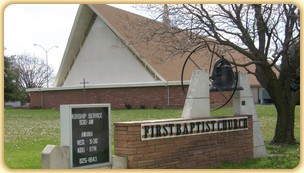
History of First Baptist Church, Salina, Kansas
On January 23, 1868, a small group met at the home of Isabel Flanders. Their purpose was to determine what steps could be taken toward organizing a Baptist Church. After much prayer and discussion, it was decided that all should send to their former church homes for their letters. These then would form the basis for the new fellowship.
Having received their letters, the group assembled at the home of S.D. Bradley on Tuesday evening, March 10, 1868, and the First Baptist Church of Salina was formally organized. The charter members were Rev. J.R. Downer, A.H. Thompson, Mary Thompson, E. Lincoln, John Spurgin, Mrs. John Spurgin, Sarah P. Spurgin, Isabel Flanders and Anna Jane Orr. Rev. Downer was invited to serve as the first pastor.
Two other churches preceded the Baptists in Salina—the Presbyterians and the Methodists. The latter invited the newly organized group to meet with them in their building for a mid-week prayer service. In addition, they granted them use of their house of worship for one Sunday service a month. At other times, for the first two years, they met in the homes of the members.
On December 5, 1868, the church made application for a Certificate of Incorporation. On December 14 the request was granted and the First Baptist Church became the first church in Salina to be incorporated under the laws of Kansas. Signatures on this certificate included J.R. Downer, J.W. Lytle, N.A. Milan, M. Thompson and N.A. Muir, and co-signers A.H. Thompson and B. Flanders.
First trustees, according to available records, were W.B. Flanders, A.M. Campbell, A.C. Thompson, H.F. Woolley, J.W. Lytle and William Muir.
On May 11, 1869, at the home of H.C. Davis, Rev. Downer presented plans for building a small chapel. Nearly $1,000 in cash and labor was subscribed by the enthusiastic members and the trustees were authorized to proceed with the work on construction.
A lot at the southeast corner of Eighth and Ash Streets was purchased, and on May 29, 1869, ground was broken for the laying of the foundation. Nearly eight months later on January 21, 1870, the church building was dedicated to the worship of God. Highlighting the service of dedication was a visit by Rev. Winfield Scott, a noted chaplain of the Civil War, as the featured speaker.
In 1882 under the leadership of Rev. A.M. Steward, a movement was started for the building of a larger house of worship in a more central location. The chapel was sold to St. John’s Baptist Church for $1,200, two hundred of which was donated to the brethren by the church.
A lot was secured at the northeast corner of Santa Fe Avenue and Mulberry Street for the new building. Membership at this time was 70. Raising money for the church proved burdensome and discouraging. Work progressed very slowly and it became necessary for members to meet in their homes. After five long wearisome years of discouragement and heavy sacrifice, the new building was ready for dedication on March 26, 1887. Rev. P.S. Hanson of the First Baptist Church of Chicago was the dedicatory speaker. However, the heavy burden of debt caused a lack of rejoicing at this service. About a year later, the members thought that the church, or at least part of the ground, should be sold to lessen the debt. No buyers appeared and, for four more years, the church labored faithfully on under the burden of debt.
In March of 1891, an exchange of properties was made with the Plymouth Congregational Church. Thus the Baptists received the property on the southwest corner of Tenth and State Streets. This consisted of a lot 75 x 1000 feet and a small frame building thereon. The Plymouth Congregational Church paid the Baptists $2,000 in cash and assumed the remaining debt of $2,000.
This exchange should have given the members new life and energy; however, Rev. H.H. Dunaway who had been the pastor for two years resigned, leaving the church without a leader for over a year and a half—at a time when one was needed the most. Attendance dwindled, Sunday School was suspended, and for a while the doors of the little church building were even closed on Sundays.
Rev. W.A.S. Sharp came to Salina in May of 1891 as an instructor in the old Normal School. Throwing his enthusiasm and energy into the work of the weakened church, he soon had it functioning again without the benefit of a pastor. Old members were revived and several new ones were added.
After four years of worshipping in the church acquired from the Congregationalists, it was again decided to locate nearer the business center of town. A lot was purchased on the west side of Seventh Street about midway between Iron Avenue and Walnut Street for $900. The church building was moved to this new location at a cost of $175. A service of rededication was held on May 26, 1895, with Dr. E.B. Meredith of Topeka as speaker.
In 1899 the membership was 100. On January 13, 1900, the lot at Tenth and State Street was sold to Frank H. Murry for $300.
On June 24, 1908, the church purchased property south of the building suitable for a parsonage for $2,100. An additional $1,400 was allowed for repair. Bro. G.W. Sheppard was delegated to raise the money.
In 1912 the membership numbered 210.
The next twenty years were fruitful ones with two strong pastors—the first, Rev. G.W. Shepard and the second, Rev. James M. Powell. On April 2, 1913, a resolution was passed that $25,000 be set as an amount for a new church building and equipment.
In May of 1913, George W. Kelly and his brother, Sankey, organized Troop No. 1 of the Boy Scouts of America in Salina, Kansas. This troop was the American counterpart of an earlier troop started by F. John Romanes (an instructor at St. John’s Military School) after the pattern of the English Boy Scouts. It was sponsored by the First Baptist Church for over 60 years (until discontinued in 1975). The earlier troop, which existed only a comparatively short time before being succeeded by the Kelly troop, was organized January 21, 1910, and is believed to have been one of the first Boy Scout troops in America.
In 1915, under Rev. Powell’s leadership, the members felt led to embark upon a building campaign. On September 15, 1915, the cornerstone was laid for the fourth building. Dr. J.T. Crawford, Secretary of the Kansas State Convention, officiated at the ceremony.
Memory of the earlier building difficulty caused the church approach this new effort with caution. As a result the work proceeded slowly on a sort of “pay as you go” plan. With the coming of WWI, work on the building was further interrupted. Rev. Powell entered YMCA overseas work in France and Rev. J.W. Bayles was called as pastor. He was able to bring the building program to a successful conclusion.
In January of 1917, the frame church building was sold to the Grand Avenue Methodist Church. On December 3, 1918, a contract was made with the Austin Pipe Organ Co. for a Type C organ at a cost of $2,550.
In June of 1919, the fourth building was completed. In recognition of this event, and to celebrate the 50th anniversary of the laying of the foundation for the First Baptist Church building in Salina, a five day series of programs was observed. Two organ recitals were given on the recently installed Austin organ by Mr. M.V. McIntyre of Oklahoma City and Mrs. Paul R. Utt of Ottawa. Rev. G.Z. Cassidy of Wichita, Joint Home and Foreign Mission Secretary, gave the main dedicatory service address on June 29.
In 1922 the church cooperated with other church of Salina in a great revival meeting under the preaching of the noted Rev. James Rayburn. Some 74 persons were added to the membership of the church. In fact 1922, under Rev. Alpha Ingle, was a banner year in that 106 new members were added.
Following this, the church enjoyed many years of quiet and substantial growth. On November 18, 1925, members approved installing a hot air furnace at a cost of $3,050. Membership stood at 572.
However, an unfortunate incident occurred in early 1935. The pastor sought by false charges to deprive many of the leaders of the church of their membership. The church’s answer to his action was to declare the pastorate vacant. This dark cloud had a silver lining for, even though some withdrew from the fellowship, it seemed to unite the congregation more solidly than ever before. It tempered them for a greater and more successful work ahead—under the leading of Rev. W.E. Simmons.
In February 1944, feeling the need of a parsonage, the church voted to purchase an attractive house with ample yard space at 944 South Santa Fe at a cost of $6,600. Within two years, the mortgage on this property was retired.
On June 28, 1946, during a flash storm, lightning struck the northeast corner of the church. Fire and smoke did eight to ten thousand dollars of damage to the building and its contents. Most of the damage was covered by insurance and the work of redecorating was started immediately.
On February 2, 1949, in order to expand the facilities, especially for Sunday School, the congregation authorized the trustees to purchase the cottage and lot immediately to the north of the building (132 South Seventh Street) for $14,000. After extensive remodeling, the “Children’s Cottage” was ready for occupancy on June 1, 1949. (Adapted from Herschel C. Logan’s historical sketch)
- December 7, 1952--The Children’s Cottage mortgage for $10,000 was burned.
- July 7, 1954—Members voted to sell the property on South Seventh to the city for a sum of $85,000.
- August 4, 1954—Members voted to purchase the entire block at Lewis and McAdams for $9,500.
- August 7, 1955—Ground breaking for the Educational Building ($214,248)
- October 1, 1955—The last service was held at 138 South Seventh.
- October 8, 1955—First worship service in the Washington High School building. Services were held in the school until the Educational Building was ready for occupation.
- March 20, 1956—The cornerstone from the old church on South Seventh was re-laid in the northeast wall of Fellowship Hall.
- June 24, 1956—The first service was held in the new Educational Building.
- September 23, 1956—Dedication of the Education Building at Lewis and McAdams.
- July 27, 1958—Air-conditioning is enjoyed in Fellowship Hall.
- December 1958—Parsonage is purchased at 1016 East Beloit.
- June 11, 1961—The mortgage on the Educational Building is burned.
- November 11, 1962—Ground breaking for the sanctuary.
- September 15, 1963—First Sunday worship in the new sanctuary.
- October 6, 1963—Dedication of the sanctuary.
- January 1, 1968—Church membership is 737.
- January 26, 1968—100th anniversary of FBC, Salina.
- June 8-9, 1968—100th Anniversary Celebration. Sunbonnets, bustles, high-top shoes, beards, bowler hats and frock coats could be seen.
- January 1, 1972—Church membership is 438. Membership rolls were revised after contacting non-resident members and names were removed of those who had joined other churches, deceased, etc.
- 1973—Parsonage at 1016 East Beloit sold.
- 1973—Bulletin board was erected on the northwest corner of the property as a memorial to Kevin Sherraden. It was understood that the bell is the one from the early First Baptist Church building.
- 1975—Boy Scout Troop 1 was discontinued.
- 1979—Church sponsored the Hongvilay family (Vietnamese refugees).
- 1979—Church wide prayer chain program established.
- 1979—Board of Christian Education recommends a full-time youth director. An intermediate step for 1980 was to hire Marcia Tyson as ¾ time youth worker with additional responsibilities in children’s work—proposed salary $4000.
- 1985—South, east, and west sides of educational wing and south side of courtyard exterior wall enclosed using stucco finish for exterior, to improve energy efficiency.
- 1987—New Johannus 3 manual electronic organ was purchased with memorial monies and installed in sanctuary.
- 1988—Computer purchased for production of worship folder and newsletter.
- 1989—Office complex is refurbished.
- 1991—Robert Sipe (builder) pipe organ purchased from Bel Aire Church, St. Louis, MO. The organ was stored for several months while sanctuary enhancements were made.
- 1992--Sanctuary enhancement/remodeling project. Pipe organ installed. East circle parking lot installed.
- August 1996—Voted to call a full-time youth pastor (Kevin Hazelton)
- 2004--Boy Scout Troop 7 was chartered at FBC.
